
Every year fellows from the Animals in Philosophy, Politics, Law, and Ethics research group (A.P.P.L.E.) release a range of books, journal articles, chapters, and reviews.
Books by APPLE Fellows
![[Animals and the Right to Politics]](/sites/applewww/files/uploaded_images/book-covers/Animals-and-the-Right-to-Politics-book-cover.jpg "Animals and the Right to Politiics")
By Sue Donaldson and Will Kymlicka
The assumption that only humans can engage in politics - that only humans are 'zoon politikon' - is foundational to the Western tradition of political philosophy. While there is increasing recognition of animals' moral status (both within moral philosophy and at the level of public opinion), animals are not recognized as political subjects.
This carefully researched but accessibly written volume - following on from the authors' earlier book Zoopolis - argues that animals too have a right to politics: a right to be recognized as political subjects and agents, and as members of political communities entitled to collective self-determination.
The book draws on recent scientific work on animal societies, cultures, and decision-making, as well as recent work by political theorists rethinking ideas of agency and community - especially the significance of emplaced and embodied encounters and relationships to the activity of politics. Sue Donaldson and Will Kymlicka draw a picture of what it would mean to create spaces and practices, not only for politics conducted by humans on behalf of animals, but also politics with and by animals on their own terms. It then explores how this approach could inform a wide range of contemporary debates in human-animal relations, including wildlife conservation, urban planning, and animal labour.
Buy Animals and the Right to Politics
(Oxford University Press, 2025)
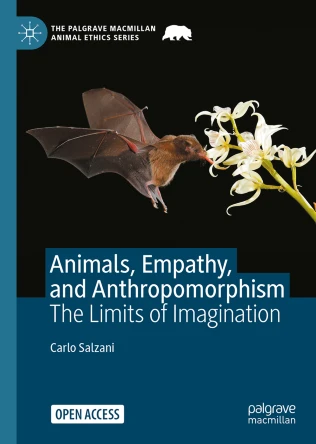
By Carlo Salzani
This open access book explores the role of imagination in animal ethics and its constitutive links to empathy/sympathy and anthropomorphism. The book argues for the constitutive role of imagination in ethical deliberation, but acknowledges that there exist important limits to its use. However, “limit” is here understood not merely negatively as restriction and insufficiency, but rather positively as “condition of possibility,” so what the book explores and analyses are the conditions for a positive and fruitful use of the imagination in ethics. The book uses as a “frame” the questions and issues raised in J.M. Coetzee’s The Lives of Animals to explore some central and salient themes.
Buy Animals, Empathy, and Anthropomorphism
(Palgrave Macmillan, 2025)
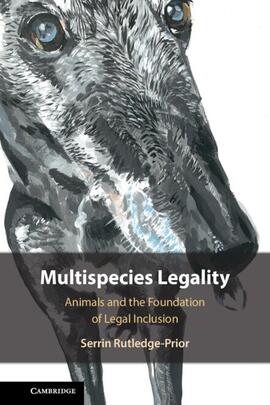
By Serrin Rutledge-Prior
Animals are unfortunately an afterthought in legal systems that have been developed to adjudicate the claims of humans and corporate entities. For those of us determined to extend the scope of justice to include animals, we must ask how to reshape our legal institutions to ensure that animal interests are considered alongside those of other, existing legal subjects. In this groundbreaking work, Serrin Rutledge-Prior departs from those who have proposed to extend legal personhood to animals, which in practice has proven to be exclusionary and inconsistently applied by the courts. Instead, Rutledge-Prior offers a new principle to ground legal inclusion based on a principle of multispecies legality that extends legal subjecthood to anyone – human or nonhuman – who possess interests.
Buy Multispecies Legality: Animals and the Foundation of Legal Inclusion
(Cambridge University Press, 2025)
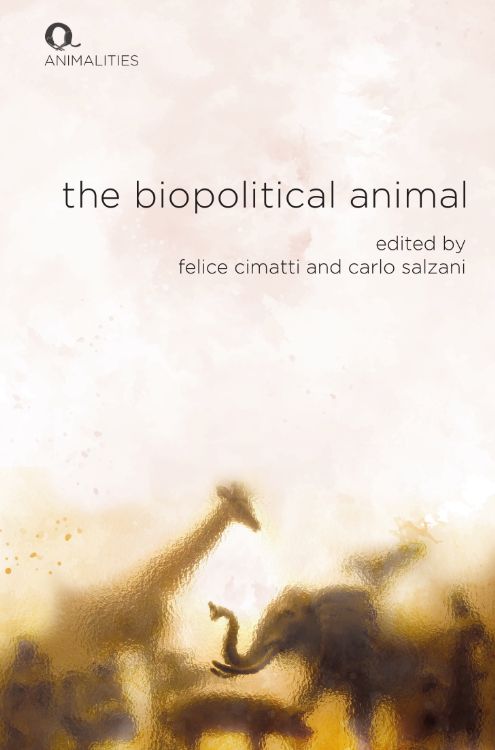
By Carlo Salzani
The two issues around which this collection revolves are that it is impossible to address biopolitics without taking the animal question into account, and that the animal question inherently concerns the politics of life beyond species barriers. Although biopolitical theories are necessarily structured around animal metaphors, they predominantly refer to human corporeality. On the other hand, the animal question is typically treated as an ethical issue, that is, a question of how human beings, the dominant species, ought to learn how to live peaceably with and respect other forms of life. This collection of essays by leading scholars in the fields of biopolitics and animal studies problematises, reconceptualises, and redefines these categories in order to realise the full potential of the biopolitical framework of analysis in the context of animal studies and praxis.
Buy The Biopolitical Animal
(Edinburgh University Press, 2024)
By Josh Milburn
In Food, Justice, and Animals: Feeding the World Respectfully, Josh Milburn questions if the vegan food system risks cutting off many people's pursuit of the 'good life', risks exacerbating food injustices, and risks negative outcomes for animals. If so, then maybe non-vegan food systems would be preferable to vegan food systems, if they could respect animal rights.
Could they? The author provides a rigorous analysis of the ethics of farming invertebrates, producing plant-based meats, developing cultivated animal products, and co-working with animals on genuinely humane farms, arguing that these possibilities offer the chance for a food system that is non-vegan, but nonetheless respects animals' rights. He argues that there is a way for us to have our cake, and eat it too, because we can have our cow, and eat her too.
Buy Food, Justice, and Animals
(Oxford University Press, 2023)
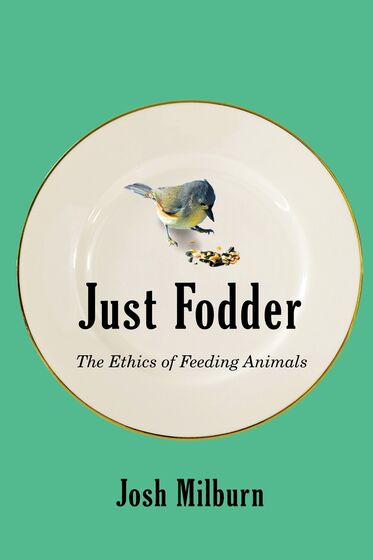
By Josh Milburn
Moving beyond what humans should eat and whether to count animals as food, Just Fodder answers ethical and political questions arising from thinking about animals as eaters. Josh Milburn begins with practical dilemmas about feeding the animals closest to us, our pets or animal companions. The questions grow more complicated as he considers relationships with more distance – questions about whether and how to feed garden birds, farmland animals who would eat our crops, and wild animals. Milburn evaluates the nature and circumstances of our relationships with animals to generate a novel theory of animal rights. Looking past arguments about what we can and cannot do to other beings, Just Fodder asks what we can, should, and must do for them, laying out a fuller range of our ethical obligations to other animals.
Buy Just Fodder
(McGill-Queen's University Press, 2023)
Edited by Valery Giroux, Kristin Voigt, and Angie Pepper
The everyday operations of animal shelters and animal protection organizations involve a host of ethical decisions. This volume is the outcome of a collaboration between a team of animal ethicists and representatives and employees of an animal shelter, the Montreal Society for the Prevention of Cruelty to Animals (Montreal SPCA). The volume offers a set of recommendations on how animal shelters can respond to the difficult ethical questions they face given the many constraints under which they must operate. These recommendations are informed by a commitment to take seriously the moral status of nonhuman animals. The volume also contains seven chapters that explore in more detail some of the ethical questions involved in everyday animal shelter operations.
Buy The Ethics of Animal Shelters
(Oxford University Press, 2023)
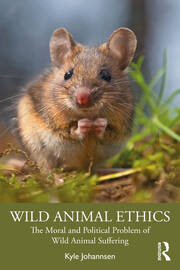
By Kyle Johannsen
Though many ethicists have the intuition that we should leave nature alone, Kyle Johannsen argues that we have a duty to research safe ways of providing large-scale assistance to wild animals. Using concepts from moral and political philosophy to analyze the issue of wild animal suffering (WAS), Johannsen explores how a collective, institutional obligation to assist wild animals should be understood. He claims that with enough research, genetic editing may one day give us the power to safely intervene without perpetually interfering with wild animals’ liberties. Expertly moving the debate about human relations with wild animals beyond its traditional confines, Wild Animal Ethics is essential reading for students and scholars of political philosophy and political theory studying animal ethics, environmental ethics, and environmental philosophy.
Buy Wild Animal Ethics
(Routledge, 2020)
Edited by Charlotte E. Blattner, Kendra Coulter, and Will Kymlicka
In this volume, an international and interdisciplinary group of scholars explores the benefits and drawbacks of animal labour as a site for interspecies justice. What kind of work is good work for animals? What kinds of labour rights are appropriate for animal workers? Can animals consent to work? Would recognizing animals as ‘workers’ improve their legal and political status, or would it simply reinforce the perception that they are beasts of burden? Can a focus on labour help create bonds between the animal rights movement and other social justice movements? These and other questions are explored in depth. While the authors defend a range of views on these questions, their contributions make clear that the question of labour deserves a central place in any account of justice between humans and animals.
Buy Animal Labour
(Oxford University Press, 2019)
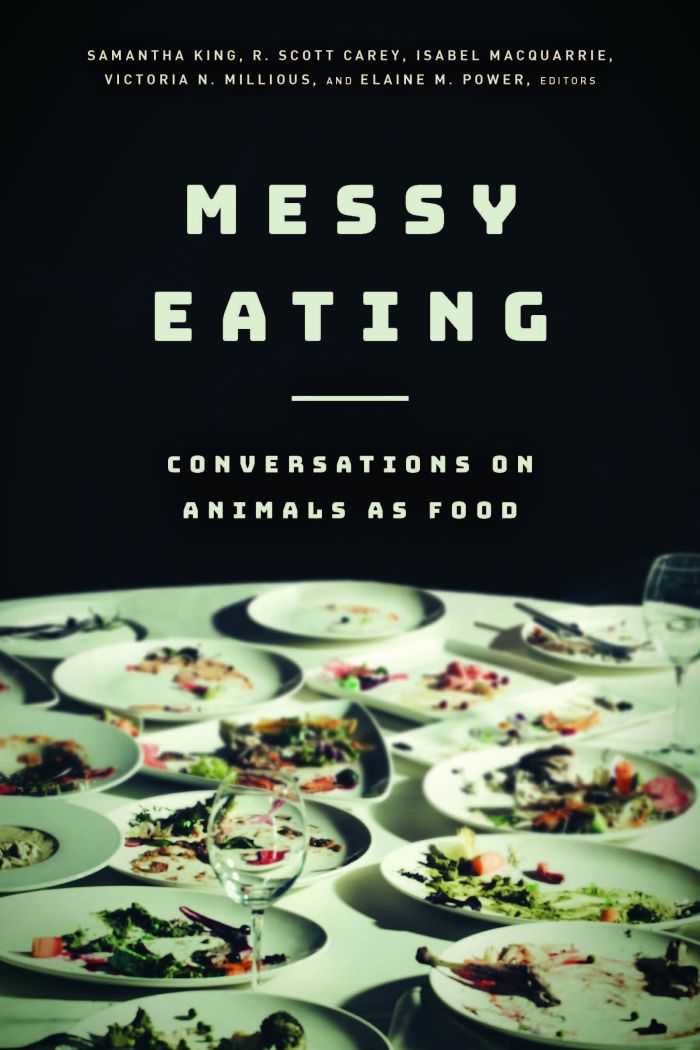
Edited by Samantha King, R. Scott Carey, Isabel Macquarrie, Victoria Niva Millious, and Elaine M. Power
Literature on the ethics and politics of food and that on human–animal relationships have infrequently converged. Representing an initial step toward bridging this divide, Messy Eating features interviews with thirteen prominent and emerging scholars about the connections between their academic work and their approach to consuming animals as food. The collection explores how authors working across a range of perspectives—postcolonial, Indigenous, black, queer, trans, feminist, disability, poststructuralist, posthumanist, and multispecies—weave their theoretical and political orientations with daily, intimate, and visceral practices of food consumption, preparation, and ingestion.
Buy Messy Eating
(Fordham University Press, 2019)
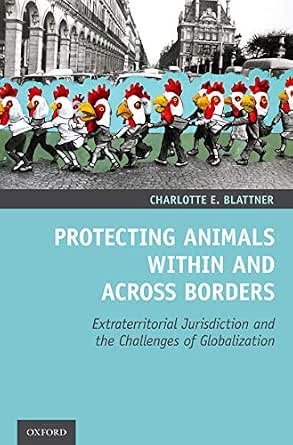
By Charlotte E. Blattner
To ensure that extraterritorial animal law does not become complicit in oppressing ethnic, cultural, or any other minorities, the book offers critical interdisciplinary perspectives, informed by studies on posthumanism and postcolonialism. Readers will further learn when and how extraterritorial jurisdiction violates international law, and the consequences of exercising it illegally under international law. This work answers questions about how and why extraterritorial jurisdiction can overcome the steepest hurdles for animal law and help us move toward a just global interspecies community.
Buy Protecting Animals Within and Across Borders
(Oxford University Press, 2019)
By Sue Donaldson and Will Kymlicka
Zoopolis offers a new agenda for the theory and practice of animal rights. Most animal rights theory focuses on the intrinsic capacities or interests of animals, and the moral status and moral rights that these intrinsic characteristics give rise to. Zoopolis shifts the debate from the realm of moral theory and applied ethics to the realm of political theory, focusing on the relational obligations that arise from the varied ways that animals relate to human societies and institutions. Building on recent developments in the political theory of group-differentiated citizenship, Zoopolis introduces us to the genuine "political animal". It argues that different types of animals stand in different relationships to human political communities.
Buy Zoopolis
(Oxford University Press, 2011)
Other Publications by Year
Donaldson, S. and Kymlicka, W., 2026. "Political Animals: Should non-humans be recognised as co-citizens, denizens and self-governing political agents?" Global Citizenship Observatory (29 September).
Gibson, J.D., 2026. "Which worlds? With whom?: Geoengineering through a relational multispecies lens," Climatic Change 179(82).
Hirtenfelder, C.T., Deininger, K., Nouioua, R., and Salzani, C., 2026. "Tierentrierte urbane Infrastrukturen der Hoffnung: Das Beispiel der Wiener Fledermause," TierEthik 18(32): 72-111.
Salzani, C., 2026. "The Bat and the Dolphin: Perception, Imagination, and the Impossibility of Empathy," In S. Caprioglio Panizza (ed) Moral Impossibility: Ethical, Poltical, and Psychological Perspectives. Routledge.
Simoneau-Gilbert, V., 2026. "Can Nonhuman Animals Hold Each Other Morally Responsible?," Ethical Theory and Moral Practice.
Castelló, P. P. 2025. "The fabric of zoodemocracy: a systemic approach to deliberative zoodemocracy," Critical Review of International Social and Political Philosophy, 1-26.
Donaldson, S., and Kymlicka, W., 2025. Animals and The Right to Politics. Oxford University Press.
Gibson, J.D., 2025. "Good Boundaries? Growing Multispecies Cultures on the Family Farm," Hypatia 40(4): 824-848.
Kurki, A.A.J. and Siemieniec, P. 2025. "Towards An Agency Turn in Animal Law," Oxford Journal of Legal Studies, 1-27.
Siemieniec, P. 2025. "Sexual and Reproductive Rights for Domesticated Animals: Beyond Population Control, Toward Affirming Bodily Integrity and Self-Determination," Journal of Animal Ethics 15(1): 67-92.
Speiran, S.I.M., 2025. "The ‘Sanctuary Gap’: Reviewing the Research on Captive Wildlife Sanctuary Tourism," Animals 15(4): 496.
Speiran, S.I.M., 2025. "A field-based Conservation Welfare Assessment Framework for Costa Rican primate sanctuaries," Human-Animal Interactions 13(1): 0011.
Weisberg, Z., 2025. "Sanctuaries as Refusal," Politics and Animals 11: 1-11.
Castelló, P. P. 2024. "Care as Method for Multispecies Ethnographies." In Chloë Taylor (ed). The Routledge Companion to Gender and Animals, Routledge, 267-281.
Castelló, P. P. 2024. With Haraway and Beyond: Towards an Ecofeminist and Contextual Vegan Ethico-Politics. Hypatia, 1-25.
Castelló, P. P. 2024. Why Seeing Is Not Believing and Why Believing Is Seeing: On the Politics of Sight. American Political Science Review, 1-11.
Castelló, P.P. and Santiago-Ávila, F., 2024. "Rethinking the mantra of biodiversity: Why the past should not determine the future," Available from Religion and Ethics.
Castelló, P. P. 2024. "Is seeing believing? Not really, so animal welfare campaigns should take a different approach." Available from The Conversation.
Cimatti, F. and Salzani, C., (eds). 2024. The Biopolitical Animal. Edinburgh University Press.
Côté-Boudreau, F. 2024. "Ableism and Speciesism: Tensions and Convergence Between Animal Rights and Disability Rights." In Y. Athanassakis et al (eds) The Plant-based and Vegan Handbook. Springer, 213-227.
Donaldson, S. 2024. "Who Are We?" In K. Allado-McDowell et. al. (eds). Interspecies Futures, A Primer.
Donaldson, S. 2024. "Sanctuary Communities." In Y. Athanassakis et al (eds) The Plant-based and Vegan Handbook. Springer, 41-50.
Fischer, J. and Fredericks, R. 2024 Creating Carnists, Philosophers' Imprint 24(18)1-20.
Guha-Majumdar, J., 2024. What Are Animals Worth? Review of Animals and Capital by Dinesh Joseph Wadiwel (2023). Humanimalia 15(1): 211-221.
Guha-Majumdar, J., 2024. “Vegans are Radical. That’s Why We Need Them,” Available from Vox.
Hirtenfelder, C.T. 2024. An analytical framework to understand the problematization of urban (historical) animals. Environment and Planning E: Nature and Space, 7(5), 2182-2203.
Hirtenfelder, C.T. 2024. Finding Traces of Cows in the Archives and Telling Stories Differently. Archivaria 98, 6-41.
Hirtenfelder, C.T. 2024. Mother Cow, Mother India: A Multispecies Politics of Dairy in India: Yamini Narayanan. The AAG Review of Books, 19-22.
Johannsen, K. (ed). 2024. Positive Duties to Wild Animals. Routledge.
Kymlicka, W. and Donaldson, S. 2024. Social Solidarity with Animals: The Case of Domesticated Animals. In Alasdair Cochrane and Mara-Daria Cojocaru (eds). Solidarity with Animals: Promises, Pitfalls, and Potential, 17-42.
Milburn, J. 2024. Relational animal ethics (and why it isn’t easy). Food Ethics, 9(1): 6.
Pepper, A. 2024. Discussion of Josh Milburn’s Just fodder: The ethics of feeding animals. Food Ethics, 9(1): 5.
Pepper, A. 2024 "Letting Beings Be: Review of What We Owe to Nonhuman Animals by Gary Steiner." Humanimalia 15 (1): 187-196.
Pepper, A, and Healey, R. 2024. "The Magpies: Reflections on Liminality, Domestication, and Animal Agency." In Paula Arcari (ed) Heterotopia, Radical Imagination, and Shattering Orders. Routledge, 99-112.
Salzani, C., 2024. Creaturely Biopolitics. In Cimatti, F. and Salzani, C., (eds). The Biopolitical Animal. Edinburgh University Press.
Weisberg, Z., 2024. "Imagining Liberation beyond Biopolitics: The Biopolitical 'War against Animals' and Strategies for ending it." In Cimatti, F. and Salzani, C., (eds). The Biopolitical Animal. Edinburgh University Press.
Benz-Schwarzburg, J. and Wrage, B., 2023. Caring animals and the ways we wrong them. Biology & Philosophy, 38(4):25.
Castelló, P.P. and Santiago-Ávila, F.J., 2023. Conservation after biodiversity: An analysis of Michael E. Soulé’s ‘What is Conservation Biology?’. Biological Conservation, 287: 110313.
Donaldson, S. and Kymlicka, W. 2023. "Transformative Animal Protection". In V. Giroux, A. Pepper and K. Voigt (eds). The Ethics of Animal Shelters. Oxford University Press.
Donaldson, S. and Kymlicka, W. 2023. Doing Politics with Animals. Social Research, 90(4): 621-47.
Janara, L. and Donaldson, S., 2023. Animal Ghosts at Canadian Universities: The Politics of Concealment and Transparency. Animals 13(24): 3760.
Guha-Majumdar, J., 2023. Can the Human Speak? Voice and Vulnerability in Kafka and Cavarero. Angelaki, Vol. 28(5): 78-96
Guha-Majumdar, J., 2023. What Are Animals Worth? Review of Animals and Capital by Dinesh Joseph Wadiwel (2023). Humanimalia 15(1): 211-221.
Kymlicka, W., and Tam, A., 2023. “Being Popular and Being Just: How Animal Protection Organizations Can Be Both.” In K. Voigt, V. Giroux, and A. Pepper (eds) The Ethics of Animal Shelters (Oxford University Press, 2023),223-246.
Lopez, A., 2023. Nonhuman Animals and Epistemic Injustice. Journal of Ethics and Social Philosophy, 25(1): 136-163.
Milburn, J. 2023. Welcoming, Wild Animals, and Obligations to Assist. Ethics, Policy, and Environments 26(2): 231-248.
Milburn, J., and Van Goozen, S. 2023. Animals and the ethics of war: a call for an inclusive just-war theory. International Relations, 37(3), 423-448.
Milburn, J., 2023. Plant sentience and the case for ethical veganism. Animal Sentience 33(5).
Oven, A., Yoxon, B., and Milburn, J., 2023. Investigating the market for cultivated meat as pet food: A survey analysis. PLoS ONE 17(12).
Pepper, A. 2023. "Caring in Non-Ideal Conditions: Animal Rescue Organizations and Morally Justified Killing." In Valery Giroux, Kristin Voigt, and Angie Pepper (eds), The Ethics of Animal Shelters, Oxford University Press, 131-165.
Siemieniec, P., 2023. Centering Animality in Law and Liberation: The Zoopolitics of Reclaiming the Animal in Personhood, Between the Species: 26(1)5.
Wrage, B., Papadopoulos, D., and Benz-Schwarzburg, J., 2023. Ubuntu in Elephant Communities. Journal of the American Philosophical Association. 1-22.
Castelló, P.P., 2022. The erasures of Peter Singer’s theory, and the ethical need to consider animals as irreducible others. Philosophy Today, 66(3): 637-653.
Castelló, P.P., 2022. A Strategic Proposal for Legally Protecting Wild Animals. Journal of International Wildlife Law & Policy, 25(2), pp.103-134.
Castelló, P.P., 2022. Zoolondopolis. Animal Studies Journal, 11(1):121-145.
Castelló, P.P. and Santiago-Ávila, F.J., 2022. Conservation after Sovereignty: Deconstructing Australian Policies against Horses with a Plea and Proposal. Hypatia, 37(1): 136-163.
Hill-Tout, K., Hirtenfelder, C., McMaster, K.E. and Herod, M., 2022. Who eats, where, what, and how? COVID-19, food security, and Canadian foodscapes. Gastronomica: The Journal of Food and Culture, 22(1): 11-19.
Hirtenfelder, C.T. and Prouse, C., 2022. Milking economies: Multispecies entanglements in the infant formula industry. Environment and Planning E: Nature and Space, 5(3), pp.1296-1318.
Kymlicka, W., 2022. Membership Rights for Animals. Royal Institute of Philosophy Supplements, 91: 213-244.
Milburn, J. and Bobier, C., 2022. New Omnivorism: a Novel Approach to Food and Animal Ethics. Food ethics 7(5): 1-17.
Wrage, B., 2022. Caring animals and care ethics. Biology & Philosophy, 37(3):18.
Donaldson, S., Vink, J., & Gagnon, J. 2021. Realizing Interspecies Democracy: The Preconditions for an Egalitarian, Multispecies, World. Democratic Theory, 8(1):71-95.
Hirtenfelder, C.T., 2021. Finding Kingston’s Animals: An Introduction and Guide to Animals in the Queen’s University Archives. (A guide).
Johannsen, K., 20201. Wild Animal Ethics: The Moral and Political Problem of Wild Animal Suffering Routledge.
Meynell, L. and Lopez, A., 2021. Gendering animals. Synthese, 199(1-2): 4287-4311.
Milburn, J., and Cochrane, A. 2021. Should We Protect Animals from Hate Speech?, Oxford Journal of Legal Studies 41(4): 1149–1172.
Milburn, J. 2021. Welcoming, Wild Animals, and Obligations to Assist. Journal of Agricultural Environmental Ethics, 34(33):1-20.
Milburn, J., and Van Goozen, S. 2021. Counting Animals in War: First Steps towards an Inclusive Just-War Theory. Social Theory and Practice, 47(4): 657–685.
Milburn, J. 2021. Zero-compromise veganism. Ethics and Education, 16(3), 375–391.
Milburn, J. and Fischer, B., 2021. The Freegan Challenge to Veganism. Journal of Agricultural Environmental Ethics, 34(17): 1-19.
Bachour, O., 2020. Alienation and animal labour. Animal Labour: A New Frontier of Interspecies Justice, pp.116-38.
Blattner, C.E., Donaldson, S., and Wilcox, R., 2020. Animal Agency in Community: A Political Multispeies Ethnography of VINE Sanctuary. Politics and Animals, 6: 1–22.
Blattner, C.E., 2020. Secondary Victimization of Animals in Criminal Procedure: Lessons from Switzerland. Journal of Animal Ethics 10(1): 1–32.
Blattner, C.E., 2020. Should Animals Have a Right to Work? Promises and Pitfalls. Animal Studies Journal 9(1): 32-92.
Côté-Boudreau, F., 2020. “Capacitisme.” In Renan Larue (ed)." La pensée végane: 50 regards sur la condition animale, Presses Universitaires de France, 135-146.
Donaldson, S., 2020. Animal Agora: Animal Citizens and the Democratic Challenge. Social Theory and Practice 46(4): 709-735.
Donaldson, S., 2020. Animals and Citizenship. Minding Nature, 13(2): 22-27.
Donaldson, S., 2020. “Les refuges d’animaux”, in La pensée végane: 50 regards sur la condition animale, edited by Renan Larue (Presses Universitaires de France, 2020), 479‑487.
Gibson, J., 2020. "Philosophy as a Way of Life" Available from the Blog of the APA, interviewed by Jeremy Bendik-Keymer.
Guha-Majumdar, J., 2020. Lyons and Tygers and Wolves, Oh My! Human Equality and the ‘Dominion Covenant’ in Locke’s Two Treatises, Political Theory, 49(4):637-661.
Healey, R. and Pepper, A., 2020. Interspecies Justice: Agency, Self-Determination, and Assent. Philosophical Studies, 178: 1223-1243.
Hirtenfelder, C., 2020. “An Uncomfortable Future We Want.” Available from the Animals in Society blog.
Johannsen, K., 2020. To Assist or Not to Assist? Assessing the Potential Moral Costs of Humanitarian Intervention in Nature. Environmental Values 29(1): 29-45.
Milburn, J., 2020. Critical Terms for Animal Studies. Environmental Politics 29(6): 1120–1121.
Milburn, J., 2020, Should Vegans Compromise? Critical Review of International Social and Political Philosophy, 25(2): 281-293.
Pepper, A., 2020. Political Agency in Humans and Other Animals. Contemporary Political Theory, 20: 296-317.
Pepper, A. 2020. Glass panels and peepholes: Nonhuman animals and the right to privacy. Pacific Philosophical Quarterly 101(4): 628-650.
van Patter, L.E. and Blattner, C., 2020. Advancing Ethical Principles for Non-Invasive, Respectful Research with Nonhuman Animal Participants. Society & Animals, 28(2): 171–190.
Bachour, O., 2019. “Alienation and Animal Labour.” In Charlotte E. Blattner, Kendra Coulter, and Will Kymlicka. Animal Labour: A New Frontier of Interspecies Justice? Oxford University Press, 116–138.
Blattner, C.E., 2019. The Recognition of Animal Sentience by the Law. Journal of Animal Ethics, 9(2): 121–136.
Donaldson, S. and Kymlicka, W., 2019. “Animal Labour in a Post-Work Society.” In Charlotte E. Blattner, Kendra Coulter, and Will Kymlicka (eds). Animal Labour: A New Frontier of Interspecies Justice? Oxford University Press, 207-227.
Fischer, B. and Milburn, J. 2019. In Defence of Backyard Chickens. Journal of Applied Philosophy, 36(1): 108–123.
Gibson, J., 2019. Just Fanciers: Transformative Justice by Way of Fancy Rat Breeding as a Loving Form of Life. Journal of Agricultural and Environmental Ethics, 32: 105–126.
King, S. et al (ed.)., 2019. Messy Eating: Conversations on Animals as Food. Fordham University Press.
Milburn, J., 2019. “Vegetarian Eating.” In Herbert L. Meiselman (eds). Handbook of Eating and Drinking: Interdisciplinary Perspectives. Springer, 1-20.
Nguyen, N.H., 2019. Bird Play: Raising Red-Whiskered Bulbuls and (Re)Inventing Urban ‘Nature’ in Contemporary Vietnam. Contemporary Social Science, 16(1):57-70.
Pepper, A., 2019. Adapting to Climate Change: What We Owe to Other Animals. Journal of Applied Philosophy, 36(4): 592–607.
Weisberg, Z., 2019. The Problem with the Personhood Argument. ASEBL Journal, 14(1): 33–36.
Blattner, C. E. 2018. Tackling Concentrated Animal Agriculture in the Middle East through Standards of Investment, Export Credits, and Trade. Middle East Law and Governance, 10(2): 141–159.
Donaldson, S. and Kymlicka, W.. 2018. “Children and Animals.” In Anca Gheaus, Gideon Calder, and Jurgen De Wispelaere (eds). The Routledge Handbook of the Philosophy of Childhood and Children, 282–293.
Kymlicka, W. 2018. Human Rights without Human Supremacism. Canadian Journal of Philosophy, 48(6): 763–792.
Kymlicka, W. and Donaldson, S., 2018. “Metics, Members and Citizens.” In Democratic Inclusion: Rainer Bauböck in Dialogue. Manchester University Press, 160–182.
Kymlicka, W. and Donaldson, S., 2018. “Rights.” In Lori Gruen (ed). Critical Terms for Animal Studies. University Of Chicago Press, 320–336.
Milburn, J. 2018. Death-Free Dairy? The Ethics of Clean Milk. Journal of Agricultural and Environmental Ethics, 31(2): 261–279.
Milburn, J. 2018. Nozick’s Libertarian Critique of Regan. Between the Species 21(1): 68–93.
Pepper, A. 2018. Delimiting Justice: Animal, Vegetable, Ecosystem? Les Ateliers de l’éthique / The Ethics Forum, 13(1): 210–230.
Van Patter, L., Tyler Flockhart, Jason Coe, Olaf Berke, Rodrigo Goller, Alice Hovorka, and Shane Bateman. 2018. Perceptions of Community Cats and Preferences for Their Management in Guelph, Ontario. Part I: A Quantitative Analysis. The Canadian Veterinary Journal / La Revue vétérinaire canadienne, 60(1): 41–47.
Van Patter, L., Tyler Flockhart, Jason Coe, Olaf Berke, Rodrigo Goller, Alice Hovorka, and Shane Bateman. 2018. Perceptions of Community Cats and Preferences for Their Management in Guelph, Ontario. Part II: A Qualitative Analysis. The Canadian Veterinary Journal / La Revue vétérinaire canadienne 60(1): 48–54.
Van Patter, L., and Hovorka, A.J., 2018. ‘Of Place’ or ‘of People’: Exploring the Animal Spaces and Beastly Places of Feral Cats in Southern Ontario. Social & Cultural Geography, 19(2): 275–295.
Weisberg, Z. 2018.“Thinking Big: Uniting Feminism and Animal Liberation in the Age of #MeToo and #Times Up.” Animal Liberation Currents (blog).
Blattner, C. E. 2017. Can Extraterritorial Jurisdiction Help Overcome Regulatory Gaps of Animal Law? Insights from Trophy Hunting. American Journal of International Law Unbound 111: 419–424.
Donaldson, S. and Kymlicka, W., 2017. “Animals in Political Theory.” In Linda Kalof (ed). The Oxford Handbook of Animal Studies. Oxford University Press, 43–64.
Johannsen, K. 2017. Animal Rights and the Problem of r-Strategists. Ethical Theory and Moral Practice, 20(2): 333-345.
Kymlicka, W. 2017. “Afterword: Realigning Multiculturalism and Animal Rights.” In Luís Cordeiro-Rodrigues and Les Mitchell (eds). Animals, Race, and Multiculturalism. The Palgrave Macmillan Animal Ethics Series, Springer, 295–304.
Kymlicka, W. 2017. Review of Garner and O’Sullivan (eds). The Political Turn in Animal Ethics. Rowman and Littlefield, 2016. Animal Studies Journal, 6(1): 175–181.
Kymlicka, W. 2017. Social Membership: Animal Law beyond the Property/Personhood Impasse. Dalhousie Law Journal, 40: 123–155.
Kymlicka, W. and Donaldson, S., 2017. “Inclusive Citizenship Beyond the Capacity Contract.” In Ayelet Shachar, Rainer Bauböck, Irene Bloemraad, and Maarten Vink (eds). The Oxford Handbook of Citizenship. Oxford University Press, 838-859.
Lopez, A., 2017. ‘The Taming of Savagery’: Kantian Perspectives on Animal Embodiment and Human Dignity.
Milburn, J. 2017. Nonhuman animals as property holders: An exploration of the Lockean labour-mixing account. Environmental Values, 26(5): 629-648.
Milburn, J. 2017. “Robert Nozick on Nonhuman Animals: Rights, Value and the Meaning of Life.” In Andrew Woodhall and Gabriel Garmendia da Trindade (eds). Ethical and Political Approaches to Nonhuman Animal Issues. Springer, 97-120.
Milburn, J. 2017. “The Animal Lovers’ Paradox? On the Ethics of ‘Pet Food.’” In Christine Overall (ed). Pets and People: The Ethics of Our Relationships with Companion Animals. Oxford University Press, 187–202.
Overall, C. 2017. “Throw Out the Dog? Death, Longevity, and Companion Animals.” In Christine Overall (ed). Pets and People: The Ethics of Our Relationships with Companion Animals. Oxford University Press, 249–63.
Pepper, A. 2017. “Justice for Animals in a Globalising World.” In Andrew Woodhall and Gabriel Garmendia da Trindade (eds). Ethical and Political Approaches to Nonhuman Animal Issues. Springer, 149-175.
Pepper, A. 2017. Political Liberalism, Human Cultures, and Nonhuman Lives. In Cordeiro-Rodrigues, L., Mitchell, L. (eds) Animals, Race, and Multiculturalism. The Palgrave Macmillan Animal Ethics Series. Palgrave Macmillan,.
Weisberg, Z. 2017.“Animal Assisted Intervention and Citizenship Theory.” In Christine Overall (ed). Pets and People: The Ethics of Our Relationships with Companion Animals. Oxford University Press, 218–233.
Weisberg, Z. “Reinventing Left Humanism: Towards an Interspecies Emancipatory Project.” In Andrew Woodhall and Gabriel Garmendia da Trindade (eds). Ethical and Political Approaches to Nonhuman Animal Issues. Springer, 121–148.
Bailey, C., 2016. Affection, comprehension et langage: L’être-au-monde animal dans les interpretations phénoménologiques d’Aristote du jeune Heidegger. Phénoménologie de la vie animale, 121-158.
Donaldson, S. and Kymlicka, W., 2016. “Comment: Between Wild and Domesticated: Rethinking Categories and Boundaries in Response to Animal Agency.” In Bernice Bovenkerk and Jozef Keulartz (eds). Animal Ethics in the Age of Humans: Blurring Boundaries in Human-Animal Relationships. Springer, 225–239.
Donaldson, S. and Kymlicka, W., 2016. “Make It So: Envisioning the Zoopolitical Revolution.” In Paola Cavalieri (ed). Philosophy and the Politics of Animal Liberation. Palgrave Macmillan, 71–116.
Donaldson, S. and Kymlicka, W., 2016. “Rethinking Membership and Participation in an Inclusive Democracy: Cognitive Disability, Children, Animals.” In Barbara Arneil and Nancy Hirschmann (eds). Disability and Political Theory. Cambridge University Press, 168–197.
Kymlicka, W. and Donaldson, S., 2016. Locating Animals in Political Philosophy. Philosophy Compass, 11(11): 692–701.
Milburn, J. 2016. Chewing Over In Vitro Meat: Animal Ethics, Cannibalism and Social Progress. Res Publica, 22(3): 249–265.
Neimanis, A. and Bailey, C., 2016. Editorial Introduction: Becoming Ecofeminisms/Devenirs écoféministes. PhaenEx, 11(1), pp.i-vi.
Pepper, A. 2016. Beyond Anthropocentrism: Cosmopolitanism and Nonhuman Animals. Global Justice: Theory Practice Rhetoric, 9(2).